
From Pitch Deck to Reality
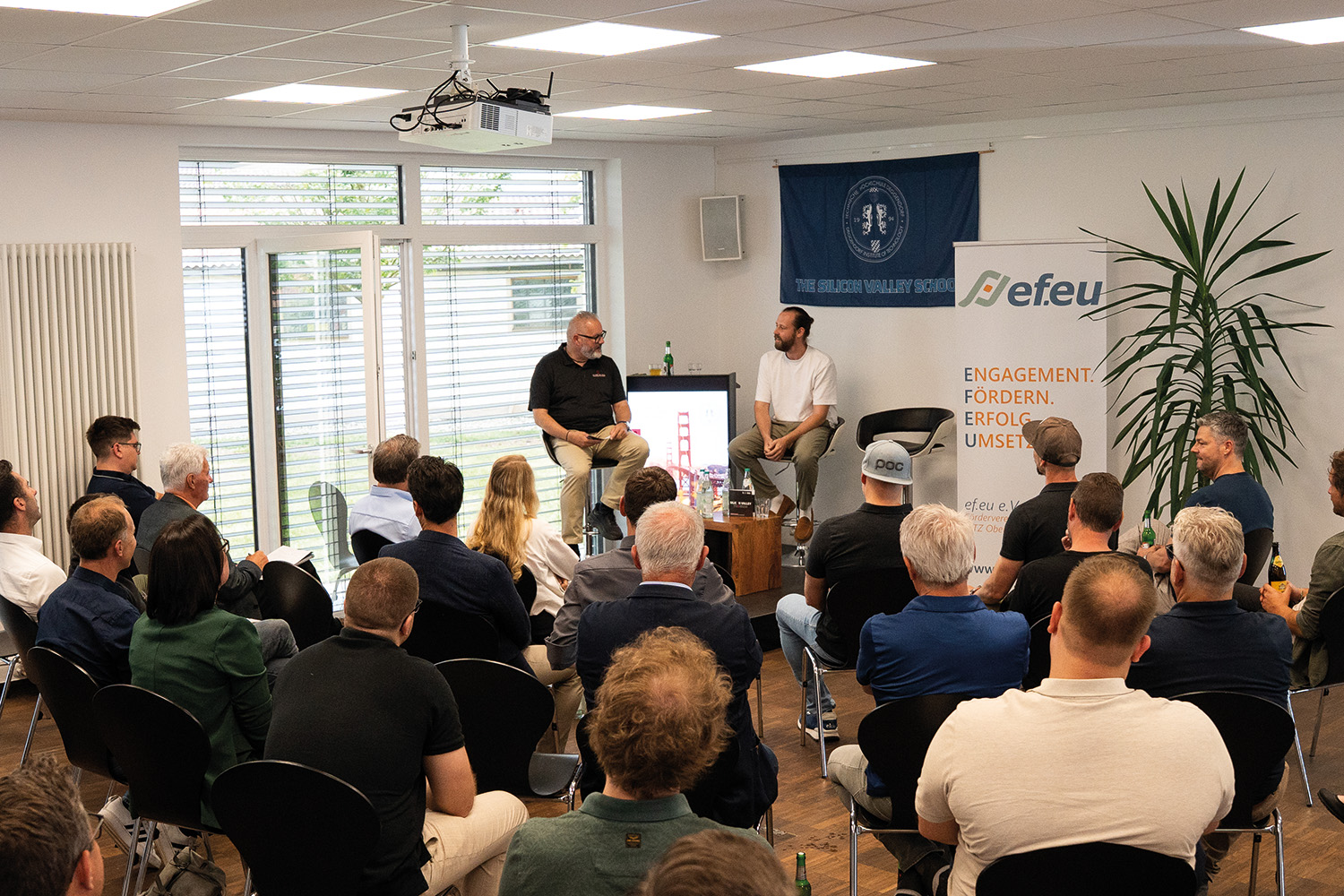
The Silicon Valley Program alumni meeting took place on Wednesday evening, 17 June, at Campus Oberschneiding of Deggendorf Institute of Technology (DIT). Around 60 participants shared their experiences, business ideas and successes. A highlight of the evening was when five Bavarian start-ups spoke about their own experiences as part of the programme.
How does a technology become a business? What did the programme actually achieve? What difficulties did the teams have to overcome? Answers to these questions were provided during moderated discussions with former teams from the Silicon Valley Program. From a brief introduction to their company and the milestones they had achieved, right through to questions from the audience, the speakers each had a good 20 minutes to share their own experiences with the participants.
On Strategic Reorientation, Financing and Takeover Bids
It all began with ReBricker, a company based in Simbach near Landau, which aims to give unused building bricks a new lease of life. Bricks lying around in cellars or attics are sorted into new sets – very much in the spirit of sustainability. What sounded like a niche offering at the start of the programme has since become an active digital platform.
Brainjo GmbH, based in Regensburg, reported on its repositioning: Having originally started out in the field of workplace health management, the company now provides an innovative virtual reality platform for evidence-based therapies. The fact that this move has paid off is demonstrated by funding of more than two million euros.
Aipama shared another success story: the start-up from Viechtach, which operates as a payroll service provider, now boasts over 1,500 corporate clients. The team emphasised that gaining an insight into American start-up culture had played a key role in helping them to think on a larger scale. Nevertheless, the founders turned down takeover and investment offers from the US.
From a founding team with just one employee to around 50 staff: This is just one of the successes achieved by the Deggendorf company PartSpace. What began in 2015 as a student project at the THD evolved into a business model through a Master’s thesis, went through start-up consultancy and the EXIST funding programme, and ultimately led to the company’s official launch. Today, the company has raised 13 million euros in a funding round for its AI software for technical procurement and cost analysis.
The final presentation was given by the team from Killwatt GmbH in Tirschenreuth. Five years ago, mentors still had their doubts about the success of the business idea. However, Prof. Peter Schmieder, the programme’s architect and head of the Oberschneiding Campus, as well as a partner in Silicon Valley, saw great potential. Killwatt is now regarded as one of Germany’s most innovative start-ups in its sector.
A network for scaling
Despite starting the Silicon Valley Program from a wide variety of backgrounds, the teams agreed on one thing at the alumni evening: The most valuable lessons are not learnt on stage, but in the years that follow, when an idea actually has to grow into a business. The aim of the Silicon Valley Program is to support the teams through precisely this critical phase between technical maturity and market success. The key to this lies in the programme’s network. “For almost every topic, there is someone with the right expertise,” says Schmieder. This, he explains, is precisely where the strength of the Silicon Valley Program lies when start-ups take the step towards scaling up.