
Between Freedom and External Control
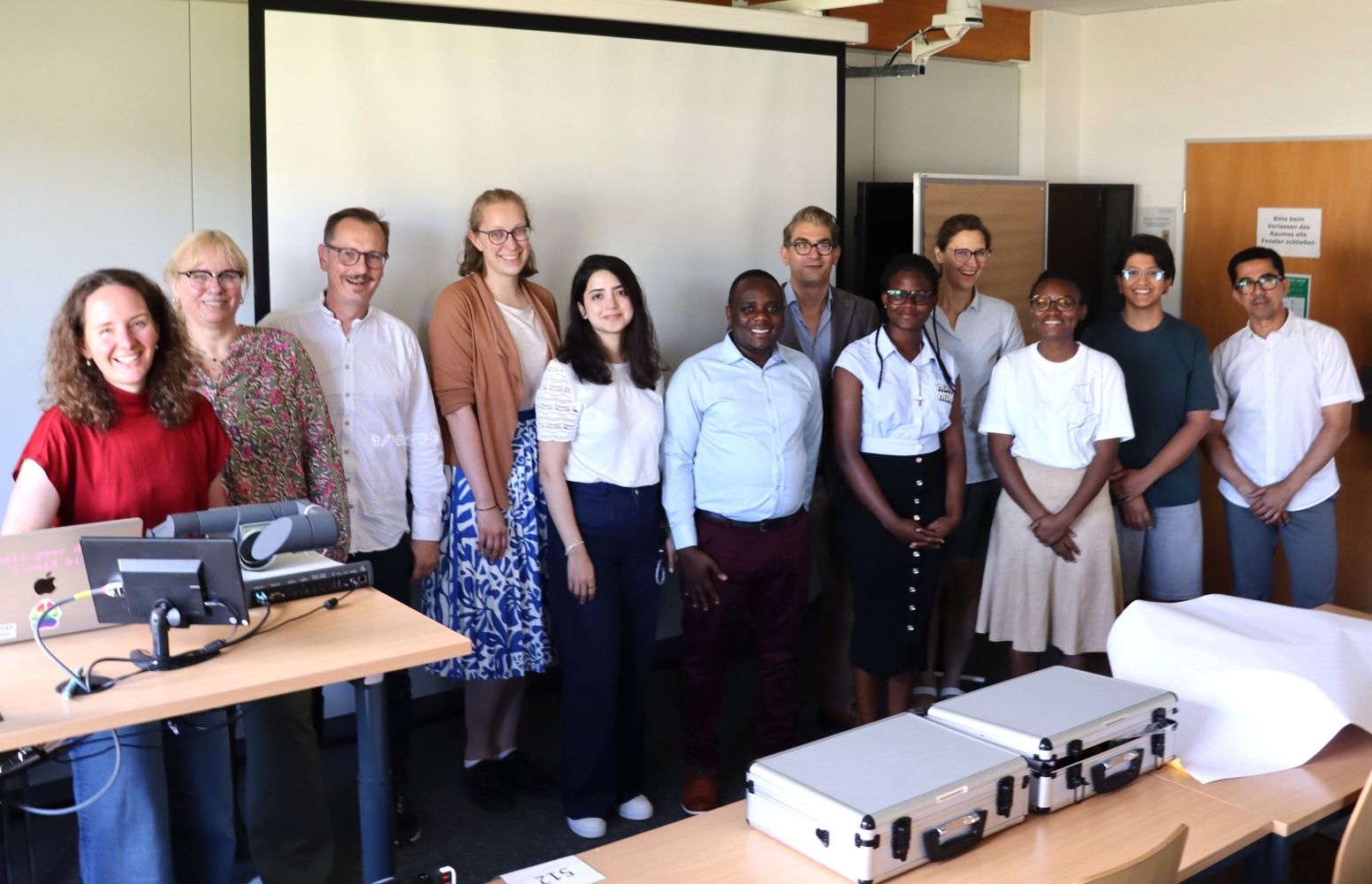
Modern technology is transforming society. Artificial intelligence (AI) is developing at a rapid pace. At the European Campus of the Deggendorf Institute of Technology (DIT), a workshop organized by the campus’s own Institute for Social Transformation (I-ETOS) explored the limits and possibilities of AI. Conclusion: In ten years, AI, humans, and society will be inextricably intertwined.
For two days, the interdisciplinary participants at the European Campus debated the central question: What influence does AI have on politics, culture, technology, and education? The open-ended discussions yielded a broad spectrum of future scenarios. These range from pessimistic warnings of a life controlled by external forces in an AI-based class society to optimistic forecasts that envision growing self-determination within the framework of new forms of governance. While, on the one hand, mass unemployment could arise and education could fall under the control of the powerful, on the other hand, a fair, just, and free society remains possible.
The bottom line is that, even with these thought experiments, the truth probably lies somewhere in the middle. Prof. Dr. Michelle Cummings-Koether noted “that the younger generation has a more positive attitude toward AI than the older generation.” There was also discussion that children and adolescents should be exposed to AI as late as possible.
Regarding the approach taken in the intensive workshop: Inspired by the so-called Delphi method, the I-ETOS team deliberately provided only a general direction for the event. Instead, the focus was on interdisciplinary swarm intelligence.
Comprehensive Interaction with AI in the Future
At the end, Prof. Dr. Cummings-Koether summarized: “In ten years, we will be interacting with AI in every aspect of our lives without even realizing it.” Prof. Dr. Matthias Hümmer also left no doubt that “humans and artificial intelligence will be mutually dependent on one another.” According to both scientists, the focus now is on better understanding the process of AI integration and actively helping to shape it. In doing so, Hümmer noted, we should keep an eye on the danger of centralizing decision-making power.
Both professors agreed: “AI is a tool; it’s up to us to use it to bring about positive change for people and society.” In line with this, DIT Vice President for Third Mission, Prof. Dr. Veronika Fetzer, encouraged “an open-minded approach.” Stephanie Schlagmann, the local chair of the Economic Forum (Wifo), made it clear that AI is also a forward-looking topic for businesses in the rural Rottal region. “This can help optimize processes, especially in small and medium-sized enterprises,” said Schlagmann. For each individual business, however, this is a major challenge.
Institute Publishes Position Paper
The workshop, with the full English title “Navigating AI-Induced Transformational Uncertainty for Humans Across Society, Politics, Culture, and Technology,” was organized by I-ETOS, short for “Institute for the Transformation of Society. Explorations, Theories, and Observations about Society.” Founded in early 2025, the institute focuses on examining human behavior from various perspectives and researching societal changes.
As part of DIT, I-ETOS is located on the European Campus in Pfarrkirchen. In addition to Prof. Dr. Michelle Cummings-Koether, an expert in intercultural communication, and Prof. Dr. Matthias Hümmer, a specialist in digital construction management, the team includes Dr. Theophile Shyiramunda, Jessica Ohnesorg, Zahra Hoseini, and Franziska Durner. I-ETOS aims to develop sustainable and equitable solutions.
Following the successful workshop, the next step will be to publish the results in a position paper in “The Journal of Applied Interdisciplinary Research” (JAIR). This English-language journal, published online by DIT, is freely accessible at: https://jas.bayern/index.php/jair.